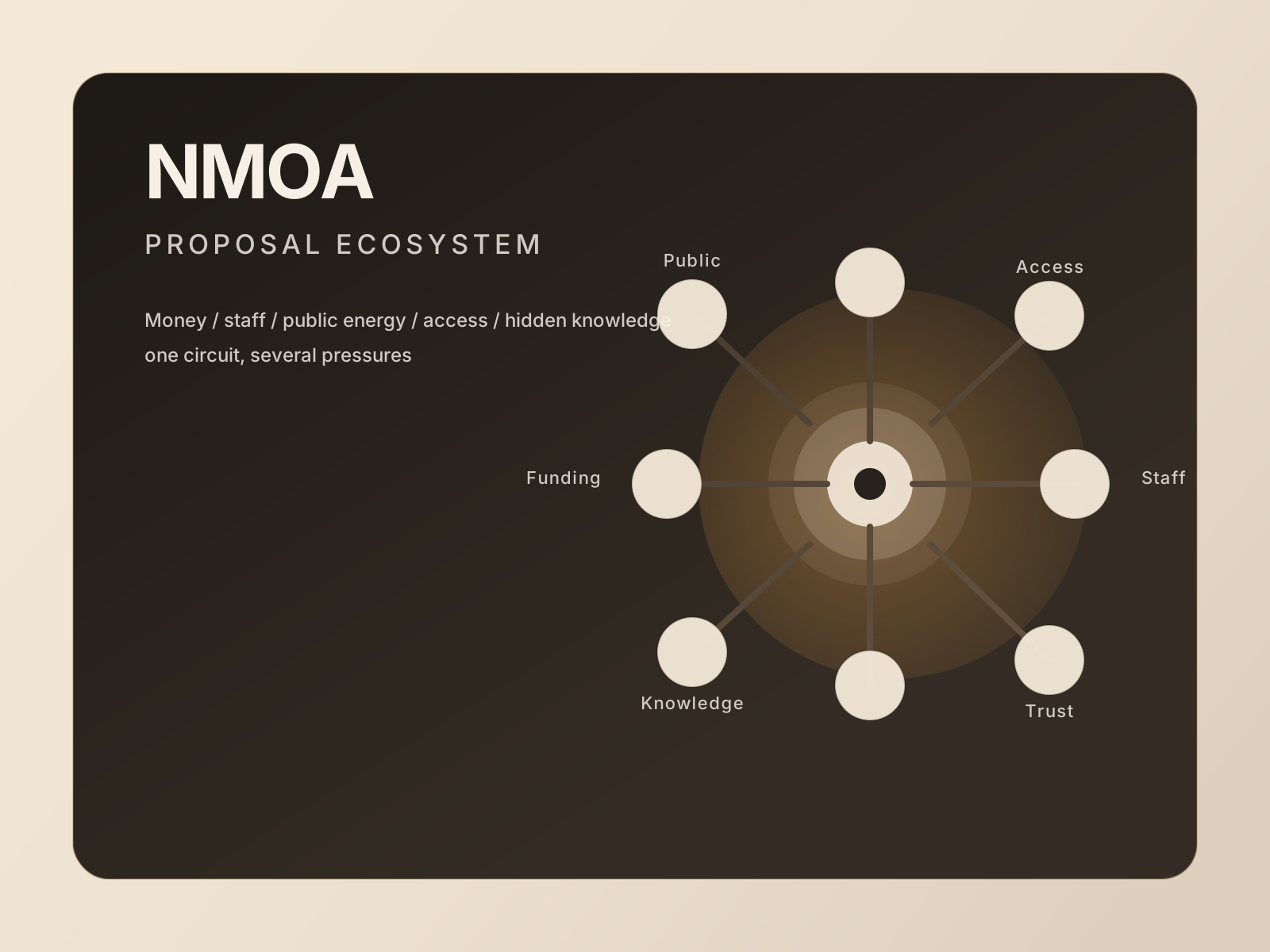
6 interlacing problems
13 materials tied to them
3 supporting layers
1 museum circuit
Main pressures in the museum
The museum as one interlacing circuit
These problems do not seem to sit separately. They behave more like one museum circuit: money pressure affects staffing, staffing affects public atmosphere, atmosphere affects return visits and support, support affects capacity, and capacity affects how much knowledge, care, and access the institution can sustain. The materials below are supporting pieces around that larger connected picture.
How it runs through the museum
Budget strain
Need for more revenue
Reliance on grants and donors
Limited flexibility
Pressure on staffing and planning
Why it matters in the circuit
When money is tight, almost everything else gets harder. Staffing, maintenance, growth, and experimentation all become more fragile.
What around the museum this touches
Income generation strategies
Grant research resources
Audited financials
Museum Parc context
How it runs through the museum
Pay pressure
Workload stress
Limited advancement
Burnout risk
Front-line strain
Why it matters in the circuit
If the people holding the museum together are stretched too thin, the public experience and the institution's long-term health both suffer.
What around the museum this touches
GH+ / Gallery Host Plus
Essential, Livable, and Thrivable Incomes
VEx Tailor Shop
Accessibility research
How it runs through the museum
Construction stress
Parking disruption
Wayfinding issues
Operational friction
Change fatigue
Why it matters in the circuit
Growth can be valuable, but when too much changes at once, staff and visitors feel the strain before they feel the benefits.
What around the museum this touches
The Next Chapter
Museum Parc context
Living Cultural Space
Income generation strategies
How it runs through the museum
Confusion around decisions
Need for transparency
Too many mixed channels
Policy/process emphasis
Trust friction
Why it matters in the circuit
Even good decisions create frustration if people cannot clearly see the reasoning, the process, or what is expected of them.
What around the museum this touches
Team communication support logic
GH+
Impact reports
The Next Chapter
How it runs through the museum
Need for repeat visitors
Need for stronger atmosphere
Destination challenge
Nightlife opportunity
Support not fully converted
Why it matters in the circuit
A museum can be respected and still not feel magnetic enough to keep drawing people back, building momentum, or growing support.
What around the museum this touches
Living Cultural Space
Nightlife venue potential
Impact reports
Income generation strategies
How it runs through the museum
Hidden materials
Slow cataloging
Hard-to-find records
Metadata gaps
Underused archives
Why it matters in the circuit
If important knowledge stays buried, the museum cannot fully use what it already has for staff, research, or the public.
What around the museum this touches
OpenAI x NMOA pilot
AI Accountability Pledge
Grant research
Institutional context files
Plans and pilots
Materials that act directly on the circuit
Direct proposal
Concrete pilot design
What it is
A recurring conversation-based museum format built around staff presence, interpretation, media, and a contained public room. Its first recommended version is Conversation Corner, with minimal equipment, short setup time, and a six- to eight-week evaluation window.
Problem addressed
The museum can feel socially static or too institution-first, while contemporary audiences often form attachment through people, scenes, clips, and repeatable activity before they deepen into the institution itself.
How this connects to the museum circuit
Strong mission, weaker pull
Change happening too fast
Where it sits in the larger picture
This proposal makes more sense when read as a response to a larger institutional need: stronger atmosphere, stronger repeat energy, and a more activated public identity during a period of museum transformation.
What it could bring
Warmer atmosphere
Repeat activation
Low-cost testing
More public conversation
Better return-visit potential
Maturity / role
This is one of the most concretely formed items in the set. It is already written like a pilot design rather than a loose theme or background note.
Source documents
Newark_Museum_Living_Cultural_Space_Proposal_v7.pdf
Draft proposal: Living Cultural Space / Conversation Corner
Direct proposal
Bounded partnership pilot
What it is
A 14-day pilot built around a 200-object dataset to test AI-assisted metadata enrichment, searchable descriptions, and interpretive support, with curator review, structured outputs, and an internal demo microsite.
Problem addressed
Under-catalogued or under-surfaced materials are harder for staff to search, interpret, and potentially expose to the public.
How this connects to the museum circuit
Too much hidden value
Weak internal communication
Where it sits in the larger picture
This is not just a tech idea. It responds to a larger museum problem: the institution likely holds more knowledge and material value than its current cataloging and retrieval systems can surface well.
What it could bring
Faster cataloging support
Better discoverability
Stronger metadata
More searchable records
Bounded AI governance
Maturity / role
This is a bounded pilot, not a museum-wide AI overhaul. Its role is to test a narrow workflow with human review before any broader expansion.
Source documents
Newarkmuseum Openai Partnership (1).pdf
08_OpenAI_Museum_Cataloging_Pilot_Draft.pdf
11_AI_Accountability_Pledge.pdf
Direct proposal
Institutional-renewal proposal
What it is
A workforce and institutional-renewal proposal built around Gallery Hosts, with structured cross-training, mentorship, wellness supports, focus weeks, peer support, wage tiers, and a longer-term fellowship pathway.
Problem addressed
Recurring pain points around wage stagnation, soft hour caps, limited benefits, weak advancement paths, lack of formal cross-training, and the physical and mental strain of Gallery Host work.
How this connects to the museum circuit
Staff support issues
Weak internal communication
Where it sits in the larger picture
This proposal responds to a core inside problem: the museum depends heavily on front-line staff while still appearing to underbuild the systems that would let those staff be supported, developed, and retained more fully.
What it could bring
Better staff support
Retention
Higher morale
Talent development
Stronger visitor-facing culture
Maturity / role
This reads as a major internal-renewal proposal rather than a tiny pilot. It is broader than a single department fix, even though it starts from Gallery Host conditions.
Source documents
GH+ core proposal variants
VEx Tailor Shop Proposals.pdf
Essential, Livable, and Thrivable Incomes.pdf
Direct proposal
Strategic financial memo
What it is
A broad financial-stability strategy memo covering ticketing, memberships, shop and e-commerce, donor cultivation, naming rights, planned giving, endowment growth, grants, partnerships, rentals, programs, and digital revenue.
Problem addressed
Over-reliance on fragile funding mixes, especially contributions and government support, plus underdeveloped earned-income and digital-revenue lines.
How this connects to the museum circuit
Money pressure
Strong mission, weaker pull
Where it sits in the larger picture
This file maps to the museum's most basic pressure: the need to become more durable, diversified, and strategically flexible instead of depending too heavily on narrower funding mixes.
What it could bring
Revenue diversity
Stronger membership
More fundraising options
Long-range stability
More flexible institutional capacity
Maturity / role
This is less a single pilot and more a strategic memo or framework. Its role is to strengthen the museum's financial base and support other initiatives over time.
Source documents
Newark Museum income generation strategies.pdf
2024-NMOA-Audited-Financials-PDF.pdf
The Next Chapter - The Newark Museum of Art.pdf
Support and research
Materials that help explain the same pressures
Support framework
Wage reality model
What it is
A Newark cost-of-living framework with category-by-category budgets for housing, food, transportation, utilities, healthcare, and more, meant to distinguish survival from modest stability and fuller accession.
Problem addressed
Compensation debates often stay abstract or anchored to legal minimums rather than real life conditions.
How this connects to the museum circuit
Staff support issues
Money pressure
Where it sits in the larger picture
This file helps make labor pressure legible. It gives the museum a more grounded way to think about wages and survival rather than defaulting to minimums or vague fairness language.
What it could bring
Wage realism
Better compensation framing
More grounded labor arguments
Clearer tier logic
Maturity / role
This is not a museum operations plan by itself. Its role is to support wage, staffing, and labor proposals with a concrete local standard.
Source documents
Essential, Livable, and Thrivable Incomes.pdf
Support framework
Evidence base
What it is
A research report centered on tactile objects, multisensory design, accessible communications, digital-tactile hybrids, staff awareness, and integrated rather than segregated accessibility practice.
Problem addressed
Museums often treat accessibility as a narrow accommodation problem instead of a full visitor-experience and communication-design issue.
How this connects to the museum circuit
Staff support issues
Strong mission, weaker pull
Where it sits in the larger picture
This supports the idea that the museum's public value is not only about programming. It is also about whether access, communication, and experience design are built deeply enough into the institution.
What it could bring
Better access design
More inclusive visitor experience
Multisensory thinking
Stronger staff awareness
Maturity / role
This reads more like an evidence base or planning resource than a finished internal policy memo. Its role is to strengthen future proposals and design choices.
Source documents
Museum accessibility and visitor engagement_.pdf
Exploratory research
Feasibility framing
What it is
Exploratory nightlife-market research about whether a large, culturally magnetic venue model could work in downtown Newark. It feeds the broader nightlife and cultural-venue line more than it stands as a polished museum proposal.
Problem addressed
Downtown Newark may still lack enough culturally magnetic, sustainable, socially alive venue models that bridge nightlife, accessibility, and public culture.
How this connects to the museum circuit
Strong mission, weaker pull
Money pressure
Where it sits in the larger picture
This helps frame a larger institutional question: can the museum become more socially magnetic and economically alive without abandoning its public mission?
What it could bring
Market realism
Nightlife context
Downtown positioning insight
Better feasibility framing
Maturity / role
This is not a finished internal museum proposal. Its role is to test whether the broader cultural-venue line has structural potential.
Source documents
Newark Nightlife Venue Potential.docx
Ethics framework
Governance support
What it is
A reconstructed ethics framework centered on transparency about where AI is used, preserved human accountability, clear privacy, consent, and data boundaries, and possible public-facing reporting or internal review.
Problem addressed
Institutional AI language can easily become vague, unaccountable, or trust-eroding.
How this connects to the museum circuit
Too much hidden value
Weak internal communication
Where it sits in the larger picture
If the museum expands AI use without clear ethical language, even a useful pilot can start to feel vague or untrustworthy. This file is the trust layer.
What it could bring
Clearer AI governance
Higher trust
Defined accountability
Better adoption boundaries
Maturity / role
This is not a museum implementation plan by itself. Its role is to serve as a governance and trust layer for AI-related proposals.
Source documents
11_AI_Accountability_Pledge.pdf
Internal care concept
Small practical support system
What it is
A Visitor Experience-only internal care system built around one locker, one sewing area, surplus uniforms, repair and customization, a Discord workflow, and the idea of a quiet internal resource that could later grow into a larger style station.
Problem addressed
Staff can end up without accessible, clean, repaired, or presentable clothing, and that becomes both a practical and dignity issue.
How this connects to the museum circuit
Staff support issues
Where it sits in the larger picture
This is a small proposal, but it is solving a real inside problem. It signals that staff care is not only about pay bands and policy but also about daily working conditions and visible institutional support.
What it could bring
Small quality-of-life gains
Better presentability
Lower stress around uniforms
Visible staff care
Maturity / role
This is narrower than the institution-wide proposals. Its role is as a practical, low-cost internal support concept inside Visitor Experience.
Source documents
VEx Tailor Shop Proposals.pdf
Institutional context
Materials that show the wider conditions around the circuit
Funding support memo
Implementation support
What it is
A grant landscape memo mapping real funding channels across IMLS, NEH, NPS, state, foundation, and corporate sources, with special attention to preservation, capacity building, HVAC, lighting, Ballantine House, and related infrastructure or collections needs.
Problem addressed
Even strong proposals stall if there is no funding path.
How this connects to the museum circuit
Money pressure
Too much hidden value
Where it sits in the larger picture
This file matters because the museum's problem is not just needing ideas. It is needing viable paths to fund those ideas in a realistic institutional environment.
What it could bring
Funding pathways
Grant realism
Implementation support
Stronger proposal viability
Maturity / role
This is a support memo, not a proposal. Its role is to connect museum needs and ideas to real funding channels.
Source documents
Newark Museum Grant Research Resources.pdf
Institutional context
Fiscal grounding
What it is
A set of audited financial documents that ground the museum's actual operating and institutional condition. They frame NMOA as a community-centered, educational, service-oriented museum while also showing the financial and structural realities any proposal has to pass through.
Problem addressed
Proposals can become detached from fiscal reality.
How this connects to the museum circuit
Money pressure
Where it sits in the larger picture
These files keep the entire ecosystem honest. They show that many smaller debates eventually route back through the same larger issue: institutional durability.
What it could bring
Fiscal realism
Better feasibility checks
Stronger internal grounding
Clearer institutional constraints
Maturity / role
These are evidence records, not proposals. Their role is to keep proposal thinking tied to real institutional conditions.
Source documents
2024-NMOA-Audited-Financials-PDF.pdf
Institutional context
Mission and public-value grounding
What it is
Mission, reach, and public-role documents. The 2022 report emphasizes inclusive experiences that spark curiosity and foster community, along with visitor, program, school, and digital reach. The 2021 report shows how the museum sustained education and public connection under hybrid conditions.
Problem addressed
Proposals often need institutional language and proof of public value, not just internal intuition.
How this connects to the museum circuit
Strong mission, weaker pull
Weak internal communication
Where it sits in the larger picture
These files help proposals speak in the museum's own language. They are useful because the institution's public mission is not the problem; the problem is how fully that mission is being converted into stable internal and external momentum.
What it could bring
Mission alignment
Public-value language
Impact framing
Stronger proposal positioning
Maturity / role
These are not proposals. Their role is to provide language, evidence, and institutional self-description that proposals can align with.
Source documents
NMOA_Impact_Report_2022_FINAL.pdf
Institutional direction document
Transformation context
What it is
A campus-transformation and institutional-direction document for 2025, focused on expanding the museum's public role, Learning and Engagement Art Center renovation, improved accessibility, Museum Parc, and a more evening-facing identity through extended activation.
Problem addressed
Without visible institutional permission, proposals for activation, atmosphere, or campus expansion can read like side ideas.
How this connects to the museum circuit
Change happening too fast
Strong mission, weaker pull
Where it sits in the larger picture
This document is important because it establishes that several proposals are not random add-ons. They sit inside a larger institutional push toward transformation, access, and public activation.
What it could bring
Transformation context
Permission structure
Long-range alignment
Better strategic fit
Maturity / role
This is a direction-setting context document. Its role is to show that several proposals sit inside a broader institutional transition rather than outside it.
Source documents
The Next Chapter - The Newark Museum of Art.pdf